Geelong Systems Thinking pilot
Great prevention starts with local leadership and tailored planning. Tailored approaches work because local people understand their own communities best.
Many networks in Geelong and surrounding areas already run place-based initiatives and governments invest in these approaches. But currently, approaches are scattered.
If these networks can be connected and are able to work together, it will prevent repeated community efforts and wasting of local resources.
A systems-thinking approach will help networks work together on the complex issues in the Geelong community.
The Geelong Systems Thinking pilot tests a method that uses existing infrastructure. It improves coordination between networks, enhances our collective impact, and boosts return on investment for everyone. It will serve as a model for communities in Australia and around the world.
Residents in parts of Geelong and the surrounding area face high levels of disadvantage.
According to the Socio-Economic Indexes for Areas (SEIFA), Norlane LGA ranks third, Whittington LGA is 18th, and Corio LGA is 26th in Australia in terms of disadvantage.
The region lags below the Victorian average on key indicators:
- youth disengagement and Year 12 completion
- unemployment, particularly youth unemployment
- low-income households, with costs rising and incomes dropping
- housing stress and homelessness
- smoking and long-term health conditions
- family violence
- suicide and hospitalisations from self-harm
- death and hospitalisations from alcohol and drugs.
To overcome deep-rooted, intergenerational disadvantage, we need ongoing efforts.
This means focusing on:
- early childhood education
- health services
- job pathways
- public transport
- social activities
- affordable housing.
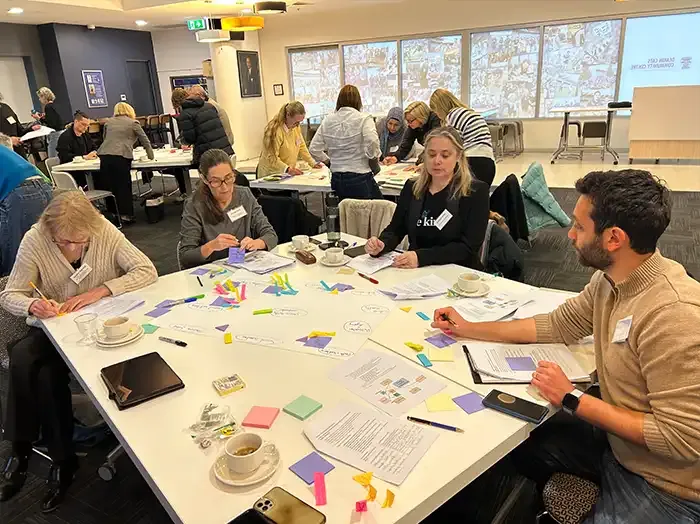
We’re running three workshops with representatives from various multi-issue networks and local action teams.
We’ll share learnings, activities, and outcomes across the networks between workshops.
Workshop 1
- Facilitator-led
- Build participant capacity for systems thinking
- Mapping out the system of a healthy and thriving community
- Identify factors being addressed
- Identify gaps and areas for action
- Identify factors to be measured.
Workshop 2
- Co-led
- Track progress on factors
- Update areas for action.
Workshop 3
- Self-led
- Track progress on factors
- Update areas for action
- Identify lead agency to embed practice.
We’re evaluating the process to check progress on key factors. We'll compare the initial and updated system maps. We'll survey and interview participants about what's working and what isn't. And, we'll suggest improvements for the future.
The Alcohol and Drug Foundation runs impactful, place-based programs. We are Australia’s top organisation dedicated to inspiring positive change and using evidence-based approaches.
Our Local Drug Action Team (LDAT) program takes a place-based approach. It helps communities boost protective factors in their area. Every community is unique. We understand that local, place-based solutions work best for supporting young people.
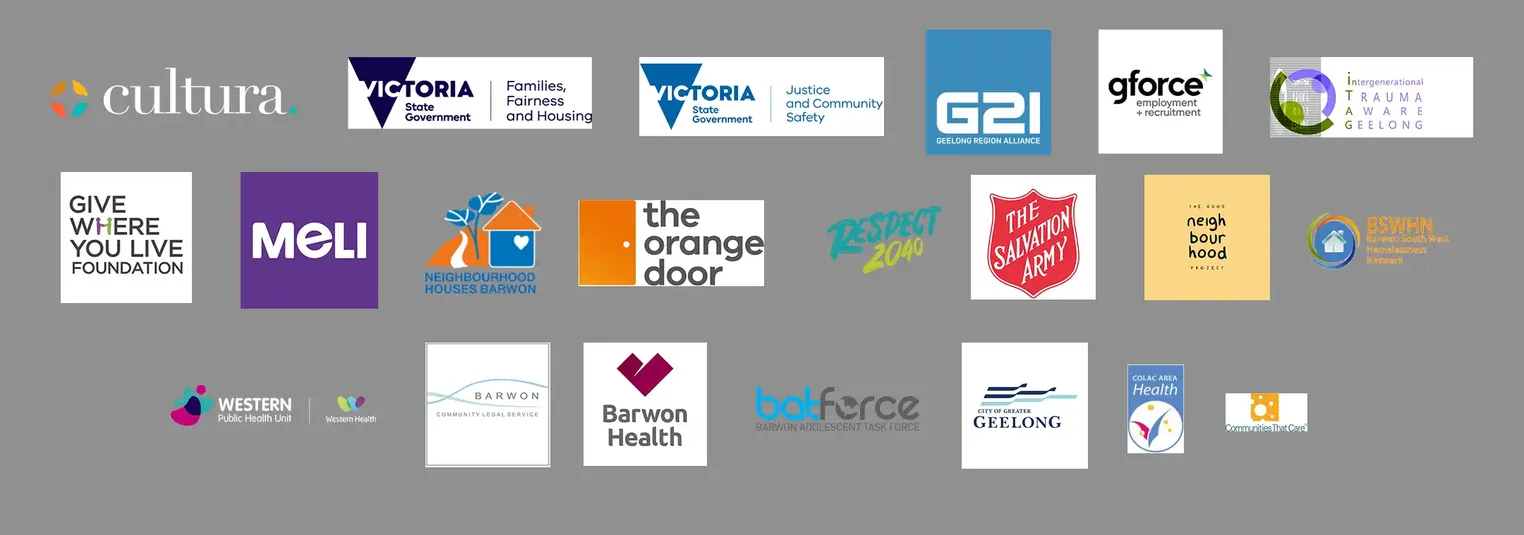
We’re collaborating with local networks and organisations to ensure local ownership of the project. This includes:
- Western Public Health Unit
- Meli
- Barwon Health
- BATForce
- The Salvation Army Australia
- Colac Area Health
- gforce
- Communities That Care
- City of Greater Geelong
- Barwon Community Legal Service
- Barwon South West Homelessness Network
- Respect 2040
- The Orange Door
- Neighbourhood Houses Barwon
- Department of Families, Fairness and Housing
- Department of Justice and Community Safety
- Intergenerational Trauma Aware Geelong
- G21 Geelong Regional Alliance
- Cultura
- Give Where You Live
- The Good Neighbourhood Project
In March 2025, we facilitated an information session with over 40 participants from 17 local place-based networks, to learn about this important initiative and seek ongoing engagement.
Some of the agreed goals of the project that came out of this session included:
- Gaps analysis; identifying and addressing gaps in services or support
- Focus on prevention; being proactive instead of reactive
- Increased power to achieve change; shift power dynamics and emphasise place-based, community-led voices
- Solution-focused
- Increased collaboration, networking and shared resources
- Intersectionality; acknowledge the diverse, unique layers that contribute to the issues in our community
- Shared voice of advocacy and collaboration.
In July 2025, we held a Foundations of Systems Thinking introduction facilitated by First Person Consulting – leaders in using systems approaches in understanding, planning and measuring social change initiatives.
The workshop covered:
- the aims of the Geelong Systems Thinking project
- an overview of systems thinking and its benefits
- exploring a simple systems map generated by First Person Consulting
- boundaries for the analysis and the project
- ways of working and what will be involved.
At the first workshop in August 2025:
- 18 participants attended, representing seven networks.
- Participants mapped out how their network contributes to a healthy and happy Geelong.
- Participants discussed what the key drivers/leaders to success within Geelong and identify barriers to a holistic approach to wellbeing
- Networks and organisations shared what they’re doing to create change, what initiatives are happening, and opportunities for partnerships
- Commitment from networks, participant hopes and fears for future workshops, collective agreement of huge potential for growth, advocacy, real change, and collaboration through this project.
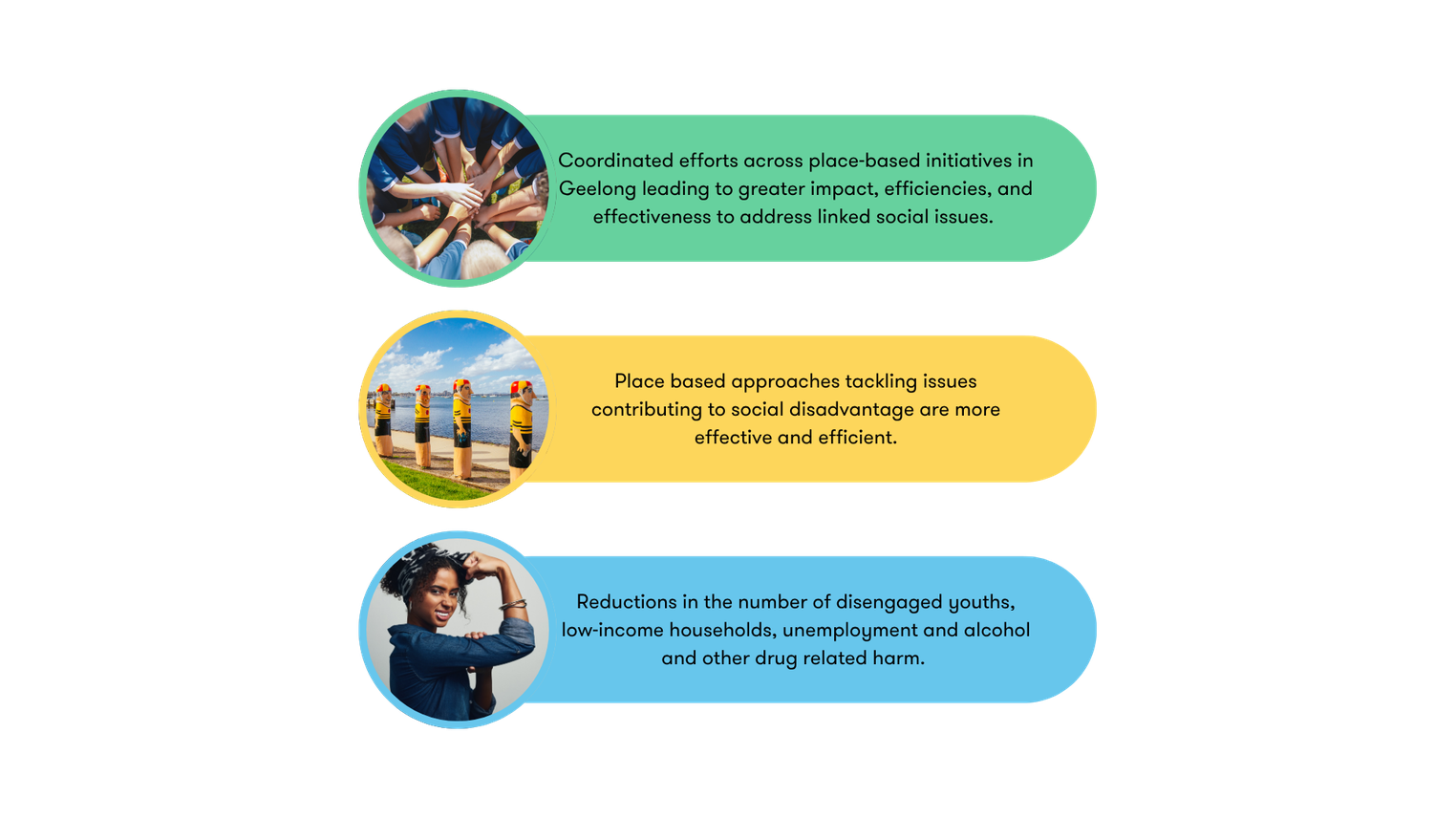
Expected outcomes
Partner organisations

Our Geelong Systems Thinking pilot is fully funded, but if you'd like to support our harm prevention efforts, please contact:
Jon King, Fundraising Lead
[email protected]
03 9611 6105
For more information, please contact:
Rusty Brennan, Regional Community Development Manager