How is LSD used?
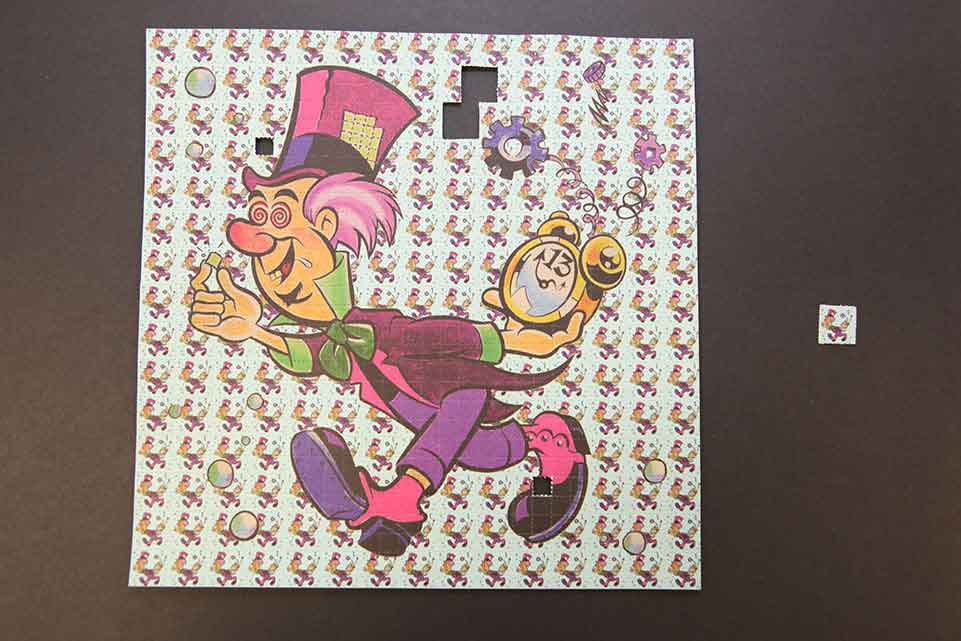
LSD is almost always swallowed or dissolved under the tongue.2, 6
LSD can also be absorbed through the skin. Wear gloves when handling liquid LSD or use tweezers for tabs to avoid skin contact.6
Effects of LSD
The use of any drug can have risks. It’s important to be careful when taking any type of drug.
LSD can affect everyone differently, based on:
- size, weight and health
- whether the person is used to taking it
- whether other drugs are taken around the same time
- the amount taken
- the strength of the drug (varies from batch to batch)
- the environment (where the drug is taken).
Onset and duration of effects
How fast a drug takes effect and how long it lasts can vary depending on how it's taken - for example, whether it's swallowed in liquid form or absorbed through blotter paper.7
If swallowed: effects can be felt within 15 to 90 minutes and can last 8 to 12 hours.5, 8, 9
Effects
Effects can include:
- euphoria and wellbeing
- anxiety
- dilation of pupils
- perceptual changes, such as visual and auditory hallucinations
- confusion and trouble concentrating
- headaches
- nausea
- fast or irregular heartbeat
- increased body temperature
- breathing quickly
- vomiting
- facial flushes, sweating and chills.2, 5
Impact of mood and environment
Drugs that affect a person’s mental state (psychoactive drugs) can also have varied effects depending on a person’s mood (often called the ‘set’) or the environment they are in (the ‘setting’):
- Set: a person’s state of mind, previous encounters with psychedelic drugs, and expectations of what’s going to happen. For example, feelings of stress or anxiety before using LSD may result in an unpleasant experience (bad trip).10
- Setting: the environment in which someone consumes LSD – whether it’s known and familiar, who they’re with, if they’re indoors or outdoors, the type of music and light. For example, using LSD in a calm, quiet and relaxed environment can contribute to, a more pleasant experience. However, being in a noisy, crowded place may result in a negative experience.10
Bad trips
A ‘bad trip’ usually includes anxiety, paranoia, panic, or other negative emotions. People can also experience unpleasant or intense hallucinations.11-13
Taking a large dose of LSD can increase the risk of a bad trip. Other things like age, sex, personality, mental state, and previous experience with the drug, also affect someone’s experience.11-13
While a bad trip can be scary, it’s generally not life threatening and the effects will go away as the drug leaves someone’s system.11-13
Most bad trips can be managed by providing reassurance and emotional support.14
Being with trusted friends, in a good state of mind, and in a safe environment before taking any psychedelic drug reduces the risk of having a bad trip.12, 15
Overdose
If you take a large amount or have a strong batch, you could overdose.
While LSD overdose deaths have been reported in Australia, most deaths linked to LSD are caused by accidents like falls or car crashes.16
Call triple zero (000) and request an ambulance if you or someone else has any of the following symptoms (emergency services are there to help and can provide more instructions).
- intense agitation or panic
- paranoia
- increased risk taking
- seizure
- chest pain
- psychosis.2, 16
Provide as much information as possible about the drug taken, the amount, timing, any other substances involved, and any pre-existing medical conditions.
Learn more on overdose and drug-related emergencies.
Mixing with other drugs
Mixing LSD with other drugs can have unpredictable effects and increase the risk of harm.
Mixing includes using more than one drug (including alcohol or medications) at the same time, or one after another. You should also consider what drugs you’ve taken in the last 24 hours.
- LSD and alcohol: can cause nausea, vomiting, can impact the desirable effects of LSD.
- LSD and ketamine: these drugs can work together to increase their effects.
- LSD and MDMA: these drugs can work together to increase both of their effects, creating a more intense psychedelic experience.
- LSD and cannabis: can increase unpredictable and negative effects. In rare cases psychosis.
- LSD and cocaine: can increase anxiety, paranoia, thought loops.
- LSD and methamphetamine (ice): can increase anxiety, paranoia and thought loops.
- LSD and nitrous oxide (nangs): can cause intense dissociation, or risk of a short negative psychedelic experience.
- LSD and psilocybin: these drugs can work together to increase effects, creating a more intense or negative psychedelic experience.9
Use of more than one drug or type of drug consumed at the same time is called polydrug use.17
More on Polydrug use
Polydrug use is a term for the use of more than one drug or type of drug at the same time or one after another. Polydrug use can involve both illicit drugs and legal substances, such as alcohol and medications.
Reducing harm
There are ways you can reduce the risk of harm when using LSD.
- NBOMes have a strong bitter taste, LSD does not. If a tab tastes bitter, spit it out and/or take a smaller dose.
- Start low, go slow - try a little bit first to see how you feel. Wait at least 5 hours before deciding whether to take more.
- Use in a safe environment with people you trust.
- Eat before using - have snacks and water with you.
- Have a calm and sober friend with you, especially if it's your first time taking LSD. This is known as having a ‘trip sitter’.
- Check for drug alerts and use drug checking (pill testing) services, where available.
- Avoid operating machinery, driving, or swimming.18-20
Avoid or use less if any of the following apply to you, as the risk of experiencing harms from taking LSD is increased:
- you have experienced symptoms or have a family history of psychosis, schizophrenia, or bipolar disorder - LSD can worsen existing symptoms and cause psychosis
- you're feeling unwell or stressed - LSD can intensify negative feelings.19, 21
Preparing for a psychedelic experience
Preparing before using psychedelics can improve your experience and reduce the risk of long-term negative effects.22-27
Psychedelic preparation means getting yourself mentally, emotionally, and physically ready. It also involves making sure you’re in a safe environment before using LSD.25, 27
Preparation usually includes:
- Keeping an open mind about what to expect: accepting that the experience may be different from what you planned can help reduce anxiety. Try to ‘go with the flow’ (as long as you feel safe).
- Understanding your mindset: be aware of your thoughts, feelings, and stress levels before using psychedelics. Some anxiety is normal, but if you feel very anxious or stressed psychedelics can make these feelings worse.
- Creating a safe environment: choose a safe place where you feel comfortable. Pick a spot where you can easily get medical help if needed.
- Preparing yourself physically: get enough sleep, eat well, and stay hydrated. Check for possible interactions with any medications or other drugs you’re taking.
- Arranging trusted support: this can include a ‘trip sitter’ during the experience and talking through your thoughts and feelings with a trusted friend or therapist afterwards (also known as integration).22-25
Coming down
In the following days after using LSD, the following may be experienced:
- insomnia
- fatigue
- body and muscle aches
- feeling depressed.2
Learn more about drug comedowns
Long-term effects
There’s limited evidence on the long-term effects of LSD.
In rare cases, use of LSD can cause:
- new or worse symptoms of some mental health conditions such as psychosis, schizophrenia, or bipolar disorder.28
These effects are rare and are more likely to be experienced by people with existing mental health concerns.28
Flashbacks and HPPD
In rare cases, use of LSD can cause flashbacks and/or Hallucination Persisting Perception Disorder (HPPD).1, 28, 29
Flashbacks and HPPD involve ongoing visual changes similar to the effects of psychedelics, even when the drug is no longer in the person’s system.28, 29
- Flashbacks: are brief visual distortions that can occur long after the drug was last taken. They usually have little or no effect on daily life and often stop within a few weeks or months.
- HPPD: involves long-lasting visual changes that can be distressing, disruptive, and can impact a person’s work or social life. HPPD is much less common than flashbacks and can persist for months or years.29
There is limited research into the causes of HPPD. Most cases come after a traumatic psychedelic experience (‘bad trip’), higher doses, and/or combining drugs.28, 29
LSD and Mental Health
Using LSD can trigger or worsen mental health conditions such as anxiety, schizophrenia or psychosis.2, 5
Anyone with a history of these issues should avoid using LSD.
However, research into the administration of LSD in a safe, therapeutic setting, involving a controlled dose, has shown positive results in treating depression, post-traumatic stress disorder, and reducing anxiety in patients with a life-threatening disease.30
Read more about some of this research here
Microdosing
Microdosing involves routinely taking very low doses of a psychedelic drug, such as psilocybin or LSD, with the aim of supporting mental health or wellbeing.31-34
For LSD, a microdose can be up to 30 times smaller than a full dose, depending how sensitive a person is to the effects of LSD. But, these doses are hard to measure without special equipment.5, 35
The aim for a microdose is to be low enough to not cause any visual effects (hallucinations), and not interrupt daily activities.31, 32
Microdosing is not a ‘cure’ for mental health or wellbeing concerns. Instead, it has been described as a tool that may support positive changes in learning or behaviour.31
Currently there is limited evidence on the effects of microdosing, and many reported benefits may be due to placebo.31, 32
Reported benefits include:
- improved mood, focus, and creativity
- increased energy
- reduced stress, anxiety, and depression.31-34
Potential risks include:
- uncomfortable body feelings such as numbness, tingling, hot/cold flushes, headaches, and appetite/stomach issues
- trouble focusing
- increased anxiety.31, 34
Tolerance
Tolerance to common psychedelics, including LSD, develops rapidly. Using LSD several days in a row makes the drug much less effective or in some cases stop working entirely.36, 37
Tolerance to one psychedelic can also affects others. For example, using LSD will reduce the effects of psilocybin (known as cross-tolerance). Tolerance will return to normal after a few days of not using psychedelics.36, 37
Dependence
There is no evidence that people who regularly use magic mushrooms will become dependent.28
Withdrawal
Withdrawal refers to the symptoms that can occur when someone who is dependent on a drug, or who has been using it regularly over time, stops or reduces their use.38
Withdrawal can include physical symptoms (such as headaches, or nausea) and psychological symptoms (such as anxiety, or depressed mood).38
Symptoms - including how strong they are and how long they last - will vary depending on the type of drug and a person’s history of use.38
There are no known LSD withdrawal symptoms, however if you experience symptoms after stopping or reducing your use, or have concerns, contact your doctor or the help and support services listed below for advice and support.2, 28
Pregnancy and breastfeeding
There is very limited information on the impact of LSD on fertility, pregnancy, and breastfeeding.39, 40
We don’t know how LSD may affect a baby’s growth during pregnancy, or their health after birth through breastmilk.40
At the moment, the best advice is to avoid using LSD if you are pregnant, trying to become pregnant, or breastfeeding.
After pregnancy
LSD can affect your awareness of the people and things around you. This can make it harder to recognise or respond to risks to you or your baby.1
Make sure that there’s always a sober, responsible person present to look after your baby if you decide to use LSD, alcohol or any other drugs.
One growing area of research is the use of psychedelics in the treatment of postnatal depression. Some early studies are showing that there may be benefits, however further research is needed.41, 42
Talk to your doctor or health care provider to see if psychedelic therapy meets your needs.
Getting help
If your use of LSD is affecting your health, family, relationships, work, school, financial or other life situations, or you’re concerned about a loved one, you can find help and support.
- Call the National Alcohol and Other Drug Hotline on 1800 250 015 for free and confidential advice, information and counselling about alcohol and other drugs
- Help and support services search
Find a service in your local area from our list. Simply add your location or postcode and filter by service type to quickly discover help near you.
If you’re looking for other information or support options, send us an email at [email protected]
Path2Help
Not sure what you are looking for?
Try our intuitive Path2Help tool and be matched with support information
and services tailored to you.

Use of LSD is against the law. Federal and state laws provide penalties for possessing, using, making, selling, importing or exporting, or driving under the influence of LSD.
See also, drugs and the law.
- 12.2% of Australians aged 14 years and over have used psychedelics one or more times in their life.43
- 2.4% of Australians aged 14 years and over have used psychedelics in the previous 12 months.43
- 61.6% of people who had recently used psychedelics reported using LSD.43
- On average young Australians (aged 14–29) first try psychedelics at 21 years of age.44
- Nichols DE. Psychedelics. Pharmacol Rev [Internet]. 2016. [cited 2026 Oct 5];68(2):264–355.
- Campbell A. The Australian illicit drug guide : every person's guide to illicit drugs--their use, effects and history, treatment options and legal penalties. Melbourne: Black Inc.; 2001. p. 547.
- Poulie C, Jensen A, Halberstadt A, Kristensen J. DARK Classics in chemical neuroscience: NBOMes. ACS Chemical Neuroscience [Internet]. 2019. [cited 2026 Nov 5]
- Suzuki J, Dekker MA, Valenti ES, Arbelo Cruz FA, Correa AM, Poklis JL, et al. Toxicities associated with NBOMe ingestion-a novel class of potent hallucinogens: a review of the literature. Psychosomatics [Internet]. 2015. [cited 29.10.2024];56(2):129–39.
- Psychonaut Wiki. LSD. 2025. [cited 2026 Oct 12]
- Harm reduction Victoria. LSD. n.d. [cited 2026 Oct 13] Available from:
- Psychonaut Wiki. Routes of administration. 2026. [cited 2026 Sep 8]
- Black E, Bruno R, Shakeshaft A, Newton N et al. Hallucinogens: What you need to know. [Internet]. UNSW Sydney: National Drug and Alcohol Research Centre. 2018. [cited 2026 Nov 4] p. 10.
- Hi-Ground. LSD. n.d. [cited 2026 Sep 9]
- Nutt D. Drugs without the hot air : making sense of legal and illegal drugs [e-book]. Cambridge: UIT Cambridge Ltd; 2012 [cited 2026 Oct 13].
- Gashi L, Sandberg S, Pedersen W. Making "bad trips" good: How users of psychedelics narratively transform challenging trips into valuable experiences. International Journal of Drug Policy [Internet]. 2021. [cited 2026 Sep 9];87:102997.
- Simonsson O, Hendricks PS, Chambers R, Osika W, Goldberg SB. Prevalence and associations of challenging, difficult or distressing experiences using classic psychedelics. Journal of Affective Disorders [Internet]. 2023. [cited 2026 Oct 21];326:105–10.
- Studerus E, Gamma A, Kometer M, Vollenweider FX, Mazza M. Prediction of Psilocybin Response in Healthy Volunteers. PloS one [Internet]. 2012. [cited 2026 Oct 21];7(2)
- Studerus E, Kometer M, Hasler F, Vollenweider FX. Acute, subacute and long-term subjective effects of psilocybin in healthy humans: a pooled analysis of experimental studies. Journal of psychopharmacology (Oxford, England) [Internet]. 2011. [cited 2026 Oct 8];25(11):1434–52.
- Palmer M, Maynard OM. Are you tripping comfortably? Investigating the relationship between harm reduction and the psychedelic experience. Harm Reduction Journal [Internet]. 2022. [cited 2026 Sep 9];19(1):81.
- Darke S, Duflou J, Peacock A, Farrell M, Hall W, Lappin J. A retrospective study of the characteristics and toxicology of cases of lysergic acid diethylamide (LSD)- and psilocybin-related death in Australia. Addiction [Internet]. 2024. [cited 2026 Sep 9];119(9):1564–71.
- Darke S, Lappin, J. & Farrell, M. The Clinician's Guide to Illicit Drugs [e-book]. United Kingdom: Silverback Publishing; 2019 [cited 2025 Mar 12].
- Giulini F, Keenan E, Killeen N, Ivers J-H. A Systematized Review of Drug-checking and Related Considerations for Implementation as A Harm Reduction Intervention. Journal of Psychoactive Drugs [Internet]. 2023. [cited 2026 Sep 4];55(1):85–93.
- Psychonaut Wiki. 25x-NBOMe. 2024. [cited 2026 Oct 16]
- Zawilska J, Kacela M, Adamowicz P. NBOMes - Highly potent and toxic alternatives of LSD. Frontiers of Neuroscience [Internet]. 2020.14
- Lawn W, Barratt M, Williams M, Horne A, Winstock A. The NBOMe hallucinogenic drug series: Patterns of use, characteristics of users and self-reported effects in a large international sample. Journal of Psychopharmacology [Internet]. 2014. [cited 2026 Oct 16]:1–9.
- Richard J, Scott J, Nayak SM, Sepeda ND, Lowe MX, Jackson H, et al. Patterns of Internalizing Problems, Substance Use and Cognitive Flexibility Before and After Naturalistic Psilocybin Use: A Repeated Measures Latent Profile Analysis. International Journal of Mental Health and Addiction [Internet]. 2026. [cited 2026 Oct 5];24(3):1974–95.
- Nordin M, Hlynsson JnI, Håkansson Eklund J, Carlbring P. A double-edged sword : Insights from practitioners on the short and long-term negative effects of psilocybin-assisted psychological interventions. Stockholms universitet, Psykologiska institutionen, University of Iceland, [Internet]. 2024. [cited 2026 Oct 6]
- Modlin NL, Miller TM, Rucker JJ, Kirlic N, Lennard-Jones M, Schlosser D, et al. Optimizing outcomes in psilocybin therapy: Considerations in participant evaluation and preparation. Journal of Affective Disorders [Internet]. 2023. [cited 2026 Oct 9];326:18–25.
- Psymerge. How to Prepare for a Psychedelic Experience: A Complete Guide. 2026. [cited 2026 Oct 12]
- Bremler R, Katati N, Shergill P, Erritzoe D, Carhart-Harris RL. Case analysis of long-term negative psychological responses to psychedelics. Scientific reports [Internet]. 2023. [cited 2026 Oct 5];13(1):15998.
- Florineth GA, Boeker AL, Müller F, Bracht T, Denier N, Jung AC, et al. Beyond the substance: A systematic review of psychological treatment frameworks in psychedelic-assisted therapy. Therapeutic Advances in Psychopharmacology [Internet]. 2026. [cited 2026 Oct 26];16
- Drug Science. LSD. n.d. [cited 2026 Oct 12]
- Hadley M, Halliday A, Stone JM. Association of Hallucinogen Persisting Perception Disorder with Trait Neuroticism and Mental Health Symptoms. Journal of Psychoactive Drugs [Internet]. 2025. [cited 2026 Oct 5];57(1):47–53.
- Liechti ME. Modern Clinical Research on LSD. Neuropsychopharmacology : official publication of the American College of Neuropsychopharmacology [Internet]. 2017. [cited 2026 Nov 4];42(11):2114–27.
- Ryan RS, Copello A, Fox AP. Experiences of microdosing psychedelics in an attempt to support wellbeing and mental health. BMC Psychiatry [Internet]. 2023. [cited 2026 Oct 5];23
- Rootman JM, Kiraga M, Kryskow P, Harvey K, Stamets P, Santos-Brault E, et al. Psilocybin microdosers demonstrate greater observed improvements in mood and mental health at one month relative to non-microdosing controls. Scientific reports [Internet]. 2022. [cited 2026 Oct 5];12(1):11091.
- National Drug & Alcohol Research Centre (NDARC). Drug Trends output: Microdosing amongst people who regularly use ecstasy and other illicit stimulants in Queensland and Tasmania, Australia 2021. UNSW Sydney,; 2022. [cited 2026 Oct 14]
- Anderson T, Petranker R, Christopher A, Rosenbaum D, Weissman C, Dinh-Williams L-A, et al. Psychedelic microdosing benefits and challenges: an empirical codebook. Harm Reduction Journal [Internet]. 2019. [cited 2026 Oct 20];16
- Yanakieva S, Polychroni N, Family N, Williams LTJ, Luke DP, Terhune DB. The effects of microdose LSD on time perception: a randomised, double-blind, placebo-controlled trial. Psychopharmacology [Internet]. 2019. [cited 2026 Oct 26];236(4):1159–70.
- Korsmeyer P, Kranzler HR. Lysergic Acid Diethylamide (LSD) and Psychedelics. Encyclopedia of Drugs, Alcohol & Addictive Behavior, [Internet]. 2009. [cited 2026 Oct 21];2:372–8.
- Nayak SM, Johnson MW. Disorders due to Substance Use: Hallucinogens and MDMA-Related Substances [e-book]. Springer, Cham; 2023 [cited 2026 Oct 14].
- NSW Ministry of Health. Management of Withdrawal from Alcohol and Other Drugs: Clinical Guidance. 2022. [cited 2026 Sep 11]
- Albert OM, Arthur A. Psychedelic exposure in pregnancy: a scoping review to inform perinatal drug safety and clinical counseling. Therapeutic Advances in Drug Safety [Internet]. 2026. [cited 2026 Oct 8];17
- MotherToBaby. Lysergic Acid Diethylamide (LSD). 2026. [cited 2026 Oct 13]
- Stein C, Penn A, Van Hope S, Dorsen CG, Mangini M. The pharmacology and clinical applications of psychedelic medicines within midwifery practice. Journal of Midwifery & Women's Health [Internet]. 2022. [cited 2026 Oct 21];67(3):373–83.
- Jairaj C, Rucker JJ. Postpartum depression: A role for psychedelics? Journal of Psychopharmacology [Internet]. 2022. [cited 2026 Oct 21];36(8):920–31.
- Australian Institute of Health and Welfare. Data tables: National Drug Strategy Household Survey 2022–2023 – 5. Illicit drugs: Table 5.97. 2024. [cited 17.10.2024]
- Australian Institute of Health and Welfare. National Drug Strategy Household Survey 2022–2023: Hallucinogens in the NDSHS. 2024. [cited 2026 Sep 9]
