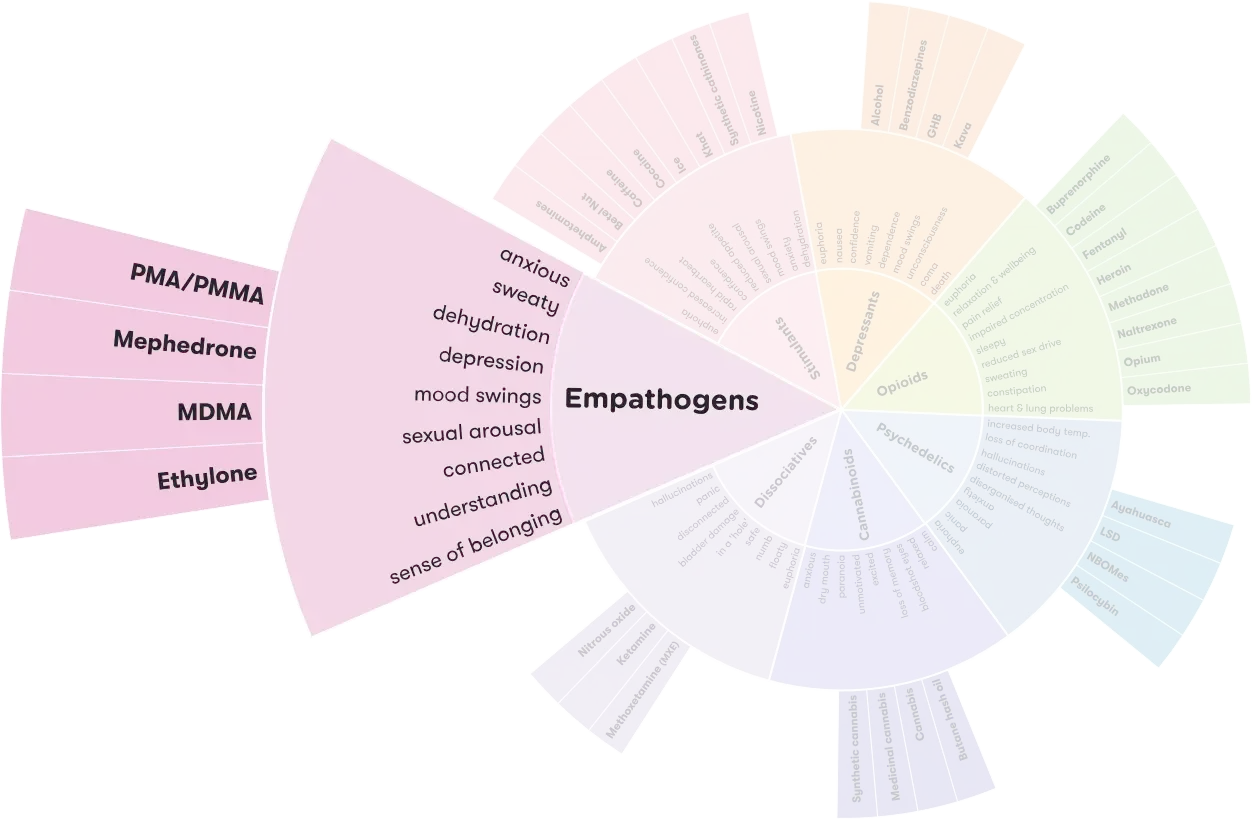
How is ethylone used?
Research on how ethylone is used is limited, however it is reported that synthetic cathinones are most commonly snorted or swallowed.6
Injecting, smoking, inhaling, as well as administering the drugs anally have also been reported.5, 6
Effects of ethylone
The use of any drug can have risks. It’s important to be careful when taking any type of drug.
Ethylone can affect everyone differently, based on:
- size, weight and health
- whether the person is used to taking it
- whether other drugs are taken around the same time
- the amount taken
- the strength of the drug (varies from batch to batch)
- the environment (where the drug is taken).
Onset and duration of effects
How fast a drug takes effect and how long it lasts can vary depending on how it's taken - for example, whether it's snorted, swallowed, or injected.7
- If swallowed: effects can be felt within 15 to 45 minutes, peak after around 60 to 90 minutes, and can last for 2 to 4 hours.8
There is limited information on how quickly effects start or how long they last when ethylone is used in other ways.
Effects
Effects can include:
- feeling happy and excited
- increased energy
- heightened senses (sight, hearing and touch)
- feelings of openness and understanding
- being more social towards others
- less inhibited
- sexual arousal
- increased blood pressure
- large pupils
- reduced appetite
- teeth or jaw clenching.6
Impact of mood and environment
Drugs that affect a person’s mental state (psychoactive drugs) can also have varied effects depending on a person’s mood (often called the ‘set’) or the environment they are in (the ‘setting’):
- Set: a person’s state of mind, previous encounters with the drug, and expectations of what’s going to happen. For example, feelings of stress or anxiety before using ethylone may result in an unpleasant experience and make those feelings worse.
- Setting: the physical and social environment where you take ethylone – whether it’s known and familiar, who you're with, if you're indoors or outdoors, the type of music or sounds, and lighting. The ideal setting to take ethylone will vary based on the individual and drug they’re using. For example, using ethylone in a relaxed environment can lead to, or contribute to, a pleasant experience but being in a noisy, crowded place may result in a negative experience.9
Being in a good state of mind, with trusted friends and a safe environment before taking ethylone reduces the risk of having a bad experience.9
Overdose
If you take a large amount of ethylone or use a strong batch, you could overdose.
Your risk of overdose can also increase if you mix ethylone with alcohol or other drugs, including medications.
Ethylone overdose can cause death.2, 10
Call triple zero (000) and request an ambulance if you or someone else has any of the following symptoms (emergency services are there to help and can provide more instructions).
- severe headache
- fast or irregular heartbeat
- sweating and hot flushes
- dehydration
- hyperthermia (high body temperature)
- cold extremities (hands, feet, legs, arms, face)
- nausea and vomiting
- severe agitation
- anxiety and paranoia
- hallucinations
- psychosis
- seizures.6
Learn more on overdose and drug-related emergencies.
Mixing with other drugs
Mixing ethylone with other drugs can have unpredictable effects and increase the risk of harm.
Mixing includes using more than one drug (including alcohol or medications) at the same time, or one after another. You should also consider what drugs you’ve taken in the last 24 hours.
- Ethylone and ice/cocaine/speed/mdma: can increase heart rate and blood pressure to dangerous levels.
- Ethylone and NBOMes: can lead to increased blood pressure, heart strain, panic attacks, thought loops, seizures.
- Ethylone and ketamine/MXE: increased risk of psychosis.8
Using more than one drug or type of drug at the same time is called polydrug use.11
More on Polydrug use
Polydrug use is a term for the use of more than one drug or type of drug at the same time or one after another. Polydrug use can involve both illicit drugs and legal substances, such as alcohol and medications.
Reducing harm
There are ways you can reduce the risk of harm when using ethylone.
As ethylone is a relatively new drug with limited research, this harm reduction advice is partly based on what is known about similar drugs like amphetamines and MDMA.
- Start low, go slow - try a little bit first to see how you feel. Wait at least 2 hours before deciding whether to take more.
- Test your drugs if there is an available drug checking (pill testing) service near you, to find out what the drugs contain and how strong they are.
- Use in a safe environment with people you trust.
- Stay hydrated - take small sips of water regularly, aiming for around 1 to 3 average-sized glasses per hour.
- Allow time for sleep or rest - getting enough sleep each day helps reduce strain on your body and brain.
- Avoid operating machinery, driving, or swimming.12, 13
If snorting
- Crush into a fine powder, as crystals can cause cuts.
- Rinse your nose with water before and after to protect your nose from irritation.
- Use your own straw, or a disposable one, and avoid money notes to reduce the risk of infections or transmission of viruses like HIV or Hep C.
- Switch nostrils and take breaks to avoid nasal damage.13, 14
If injecting
- Always use new needles - never share needles or other injecting equipment. Use your own spoon/cup and tourniquet. Use new barrels, filters, sterile water, and swabs. Safely dispose of used equipment.
- Visit a needle and syringe program for sterile equipment, disposal of used equipment, and expert medical advice.12, 14, 15
Coming down
In the days after using ethylone, you may experience:
- anxiety
- fatigue
- a lack of motivation
- difficulty sleeping
- feeling depressed
- feeling easily annoyed or angered.8
Learn more about drug comedowns here.
Long-term effects
The long-term health effects of ethylone use are not well-known, as it has not been researched.8
Ethylone and mental health
Reports have shown that some people can experience psychosis after taking ethylone or other synthetic cathinones, especially at high doses.2, 6
People who have previously experienced psychotic symptoms should be cautious about using ethylone.
Tolerance
Regularly taking ethylone may lead to developing a tolerance, which means you need to take larger amounts to get the same effects.8, 16
Dependence
There is limited evidence that people who regularly use ethylone will become physically dependent.2
However, people who regularly use ethylone may become psychologically dependent. They may feel they need to use ethylone to go about usual activities like working, studying and socialising, or just to get through the day.8, 16
Withdrawal
Withdrawal refers to the symptoms that can occur when someone who is dependent on a drug, or who has been using it regularly over time, stops or reduces their use.17
Withdrawal can include physical symptoms (such as headaches, or nausea) and psychological symptoms (such as anxiety, or depressed mood).17
Symptoms - including how strong they are and how long they last - will vary depending on the type of drug and a person’s history of use.17
There is limited evidence on withdrawal symptoms relating to ethylone. However, reports suggest that withdrawal effects may occur if a person suddenly stops their usage.8
Pregnancy and breastfeeding
There isn’t enough information about the effects of ethylone on fertility. Like other illicit drugs, it is recommended to avoid using them if you’re trying to get pregnant, to increase your chances of a healthy pregnancy and baby.
Getting Help
If your use of ethylone is affecting your health, family, relationships, work, school, financial or other life situations, or you’re concerned about someone, there is help and support.
- Call the National Alcohol and Other Drug Hotline on 1800 250 015 for free and confidential advice, information and counselling about alcohol and other drugs.
- Search our Help and Support directory to find your preferred support, by adding your location or postcode and filtering by service type.
If you’re looking for other information or support options, send us an email at [email protected]
Path2Help
Not sure what you are looking for?
Try our intuitive Path2Help tool and be matched with support information
and services tailored to you.

In Queensland, New South Wales, South Australia and Victoria there is now a ‘blanket ban’ on possessing or selling any substance that has a psychoactive effect other than alcohol, tobacco and food.
In other states and territories in Australia specific New Psychoactive Substances (including synthetic cathinones) are banned and new ones are regularly added to the list. This means that a drug that was legal to sell or possess today, may be illegal tomorrow. The substances banned differ between these states/territories.18
See also, drugs and the law.
The Ecstasy and Related Drugs Reporting System (EDRS) surveys people who regularly use MDMA (ecstasy) or other illicit stimulants in Australian capital cities. The results are not representative of all people who use drugs or the general population.19
In 2026:
- 10% of people that were interviewed had used a novel psychoactive substance, including synthetic cathinones such as ethylone, in the past 6 months.19
- Kuhn C, Swartzwelder S, Wilson W, Wilson LH, Foster J. Buzzed : the straight facts about the most used and abused drugs from alcohol to ecstasy [e-book]. 3rd ed. New York, NY: W.W. Norton; 2008 [cited 2026 Sep 9].
- Lee D, Chronister, C., Hoyer, J., & Goldberger, B. Ethylone-Related Deaths: Toxicological Findings. 39 [Internet]. 2015. [cited 2026 Oct 23];7:567–71.
- de Dios M, Monteagudo, E., Trabsa. A., Grifell, L., Galindo, L., Quintana, P.,Palma, A., Ventura, M., Sanagustin, D., Pérez, S. & Torrens, M.,. Ethylone: A synthetic cathinone emerging in Barcelona. European Psychiatry [Internet]. 2017. [cited 2026 Oct 23];41
- German C, Fleckenstein, A. & Hanson G. Bath salts and synthetic cathinones: An emerging designer drug phenomenon. Life Sciences [Internet]. 2013. [cited [24.05.2024];97(1):2–8.
- World Health Organization. Ethylone Critical Review Report. [Internet]. Geneva 2016. [cited 2026 Oct 23] p. 23.
- Paillet-Loilier M, Cesbron, A., Le Boisselier, R., Bourgine, J. & Debruyne, D.,. Emerging drugs of abuse: current perspectives on substituted cathinones. Substance Abuse and Rehabilitation, [Internet]. 2014. [cited [24.05.2024];5:37–52.
- Psychonaut Wiki. Routes of administration. 2026. [cited 2026 Sep 8]
- PsychonuatWiki. Ethylone. 2025. [cited 2026 Oct 23]
- Nutt D. Drugs without the hot air : making sense of legal and illegal drugs [e-book]. 2nd ed. Cambridge: UIT Cambridge Ltd; 2020
- Prosser JM, Nelson LS. The Toxicology of Bath Salts: A Review of Synthetic Cathinones. Journal of Medical Toxicology [Internet]. 2012.8(1):33–42.
- Darke S, Lappin J, Farrell M. The clinician's guide to illicit drugs and health [e-book]. Silverback Publishing; 2019
- Giulini F, Keenan E, Killeen N, Ivers J-H. A Systematized Review of Drug-checking and Related Considerations for Implementation as A Harm Reduction Intervention. Journal of Psychoactive Drugs [Internet]. 2023. [cited 2026 Sep 4];55(1):85–93.
- Hi-Ground. MDMA. n.d. [cited 2026 Oct 28]
- Harm Reduction Victoria. Safer Using Tips poster #1. 2016. [cited 2026 Sep 11]
- Harm Reduction Victoria. Safer Using Tips poster #2. 2016. [cited 2026 Sep 11]
- Coppola M Mondola R. Synthetic cathinones: chemistry, pharmacology and toxicology of a new class of designer drugs of abuse marketed as "bath salts" or "plant food". Toxicolgy Letters [Internet]. 2012. [cited [24.05.2024];211(2):144–9.
- NSW Ministry of Health. Management of Withdrawal from Alcohol and Other Drugs: Clinical Guidance. 2022. [cited 2026 Sep 11]
- National Drug & Alcohol Research Centre (NDARC). New (and emerging) Psychoactive Substances (NPS): NDARC fact sheet. [Internet]. 2016. [cited 2026 Aug 13]:3.
- Sutherland R, Karlsson A, Chandrasena U, Uporova J, Palmer L, Chrzanowska A, et al. Australian Drug Trends 2026: Key Findings from the National Ecstasy and Related Drugs Reporting System (EDRS) Interviews. [Internet]. Sydney: National Drug and Alcohol Research Centre, UNSW Sydney. 2026. [cited 2026 Oct 14] p. 136.