How are they used?
Most often, benzos are swallowed. They can also be injected or administered rectally, more commonly in medical settings.5
Effects of benzodiazepines
The use of any drug can have risks. It’s important to be careful when taking any type of drug.
Benzodiazepines affect everyone differently, based on:
- size, weight and health
- whether the person is used to taking it
- whether other drugs are taken around the same time
- the amount taken
- the strength of the drug (varies from batch to batch)
- the environment (where the drug is taken).
Onset and duration of effects
How fast a drug takes effect and how long it lasts can vary depending on which benzodiazepine you take and how it's taken - for example, whether it's swallowed or injected.6
Benzodiazepines stay in your system for many hours after you’ve stopped feeling the effects, meaning if you re-dose, your risk of overdose is increased.
Because of this, knowing the half-life of benzos can help you better understand how long it will stay in your body.
Half-life is how long it takes for 50% (half) of the drug you took to leave your body. Generally, it takes 4-5 half-life durations for a drug to have mostly left your body and no longer have any effects.7 For example, if you have 50 mg of a drug in your body and its half-life is 24 hours:
- about 25 mg would remain after 24 hours
- 12.5 mg after 2 days
- 6.25 mg after 3 days
- 3.125 mg after 4 days.
Prescribed benzodiazepines
| Generic name | Brand name | Peak of effects (swallowed) | Duration of effects | Half-life |
|---|---|---|---|---|
| Diazepam | Antanex®, Ducene®, Valium®, Valpam® | 30-90 mins | Long | 24-48 hours |
| Clonazepam | Paxam®, Rivotril® | 2-3 hours | Long | 20-60 hours (average 30 hours) |
| Nitrazepam | Alodorm®, Mogadon® | 0.5-2 hours (average 2 hours) | Intermediate | 24 hours |
| Lorazepam | Ativan® | 2 hours | Intermediate | 12-24 hours |
| Oxazepam | Alepam®, Murelax®, Serepax® | 2-3 hours | Short | 4-20 hours |
| Temazepam | Euhypnos®, Normison® | 30-60 mins (tablets) 2 hours (capsules) | Short | 5-15 hours |
| Alprazolam | Kalma®, Alprax®, Xanax® | 1 hour | Short | 6-25 hours |
Adapted from: Horowitz, M. & Taylor, D. M. 2024. The Maudsley Deprescribing Guidelines: Antidepressants, Benzodiazepines, Gabapentinoids and Z-drugs, New York, Wiley-Blackwell.2
Effects
Effects can include:
- reduced anxiety
- feeling calm
- drowsiness, sleepiness
- fatigue
- relaxed muscles
- reduced coordination
- impaired thinking
- lower inhibitions
- intense pleasure
- dizziness
- impulsive behaviours
- short term memory loss
- slurred speech.2, 5
In some cases, even when only taken occasionally, benzos can have the opposite of the intended calming effect, causing increased anxiety, trouble sleeping, excessive talking, restlessness and mania. On rare occasions, they can cause anger or aggressive behaviour. Key risk factors for these unintended symptoms include older age, dementia, a history of alcohol use, and mood disorders.5
Impact of mood and environment
Drugs that affect a person’s mental state (psychoactive drugs) can also have varied effects depending on a person’s mood (often called the ‘set’) or the environment they are in (the ‘setting’):
- Set: a person’s state of mind, previous encounters with the drug, and expectations of what’s going to happen. For example, someone is unlikely to feel the anxiety reducing effects of benzodiazepines if they don’t have anxiety, instead they may feel more sleepy or drowsy.
- Setting: the physical and social environment where you take benzodiazepines – whether it’s known and familiar, who you're with, if you're indoors or outdoors, the type of music or sounds, and lighting. The ideal setting to take benzodiazepines will vary based on the individual and drug they’re using. For example, one person might use benzodiazepines in a loud or busy social setting, while another may prefer being at home resting.8
Being in a good state of mind, with trusted friends and a safe environment before taking benzos reduces the risk of having a bad experience.8
Overdose
If you take a large amount of benzodiazepines or use a strong batch, you could overdose.
While overdose from prescribed benzodiazepines alone rarely causes death, an overdose from novel benzos, or a mix of benzos and other depressants or opioids, greatly increases the risk of death.9
Call triple zero (000) and request an ambulance if you or someone else has any of the following symptoms (emergency services are there to help and can provide more instructions).
Symptoms include:
- unconscious or non-responsive
- slow breathing, abnormal breathing, or not breathing at all
- slow or no heartbeat and pulse
- choking or gurgling sounds
- skin colour changes, especially lips and fingernails
- bluish-purple skin for people with lighter complexions
- greyish or ashen skin for people with darker complexions
- vomiting
- cool or clammy (wet and sweaty) skin.10
Mixing with other drugs
Mixing benzodiazepines with other drugs can have unpredictable effects and increase the risk of harm. Mixing includes using more than one drug (including alcohol or medications) at the same time, or one after another. You should also consider what drugs you’ve taken in the last 24 hours.
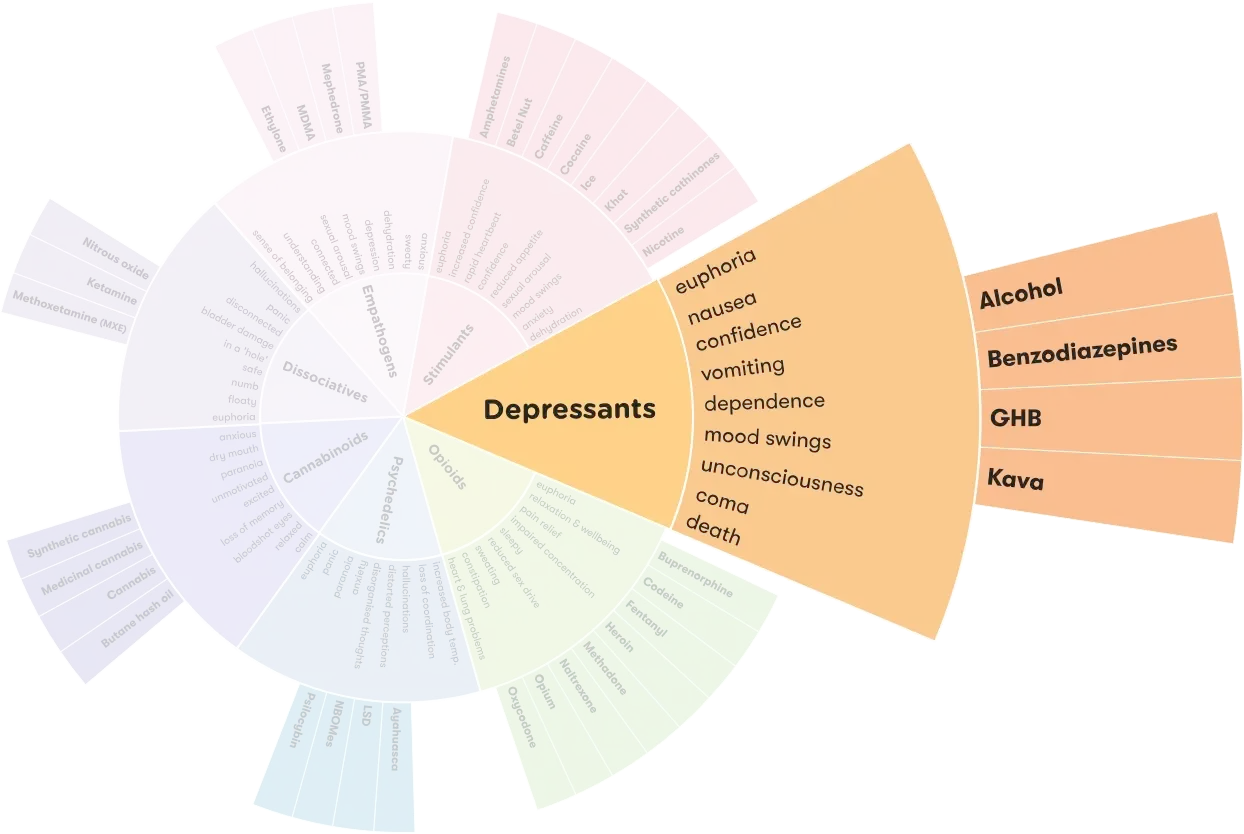
- Benzodiazepines and other depressants (alcohol, GHB) or opioids (such as heroin): can dangerously slow breathing, increasing risk of overdose, coma and death. Increases risk of choking on vomit if not in the recovery position. Also increases risk of short-term memory loss.11
- Benzodiazepines and dissociatives (ketamine, DXM, MXE): can make you more uncoordinated and tired. At high doses, you may suddenly lose consciousness. If you vomit while unconscious, there’s a risk of choking on the vomit.11
- Benzodiazepines and stimulants (methamphetamine, amphetamines, cocaine): can mask the effects that each drug is having. This can lead to taking higher doses and may result in an overdose if one drug wears off before the other. Regularly using benzodiazepines to help with the come down effects of stimulants can also lead to dependence on both drugs.12
- Benzodiazepines and some pharmaceutical drugs: strong pain-relievers, antidepressants, anticonvulsants, anti-psychotics, some antihistamines and over-the-counter medications can have an adverse effect when taken with benzos. This can lead to impaired coordination and memory, drowsiness, poor balance and coordination and possibly slower breathing.5
Using more than one drug or type of drug at the same time is also called polydrug use.10
More on Polydrug use
Polydrug use is a term for the use of more than one drug or type of drug at the same time or one after another. Polydrug use can involve both illicit drugs and legal substances, such as alcohol and medications.
Reducing harm
There are ways you can reduce the risk of harms when using benzodiazepines.
- Always use as prescribed - if you’re taking benzodiazepines prescribed by your doctor.
- Start low, go slow - if you’re taking illicit benzos, try a little bit first to see how you feel and leave plenty of time before redosing. Benzos can stay in your system for many hours after you stop feeling the effects.
- Check for drug alerts and use drug checking (pill testing) services - where available.
- Look out for counterfeit benzos - they’re often sold in a medicine bottle and look identical to prescription benzos. Any benzos not from a pharmacy or doctor could contain novel benzos.
- Use somewhere safe and around people you trust - high doses of benzodiazepines can cause memory loss.
- Avoid mixing with other drugs - especially alcohol and opioids, as they greatly increase your risk of overdose.
- Only use short term - regular, daily use can cause dependence. And withdrawals from benzodiazepines can be dangerous and cause death.
- Avoid potentially risky activities - like driving, swimming and operating machinery while affected by benzodiazepines.
Avoid or use less if any of the following apply to you, as the risk of experiencing harms from taking benzodiazepines is increased:
- older adults – use can increase the risk of falls and injury
- people with acute asthma, emphysema or sleep apnoea
- people with advanced liver or kidney disease
- people with a history of alcohol or other drug dependence.2
Injecting benzodiazepines
Many benzodiazepines do not dissolve well in water, even when heated. In medical settings, propylene glycol or another medical-grade liquid is used to dissolve benzos.13
Injecting them can introduce undissolved particles into the bloodstream, which may block small blood vessels, reduce blood flow, and in severe cases cause tissue damage that can lead to amputation.13
Repeatedly injecting benzodiazepines or sharing injecting equipment with other people also increases the risk of vein damage, serious infections and blood clots.13
If you’re injecting benzodiazepines:
- Visit a needle and syringe program for new sterile injecting equipment, learn and follow safer injecting practices, and consider using a supervised injecting facility.
- Use pill (wheel) filters, if you can get them. If not, filter your mix at least three times to remove impurities that can cause problems to veins and blood flow.
- Consider crushing the pill up and dissolving it under your tongue or taking it rectally, instead of injecting.13
Coming Down
After the effects of benzos have worn off you may experience:
- anxiety
- panic attacks
- trouble sleeping
- irregular dreaming
- feeling tired
- trouble focussing
- fatigue.14
Some of the comedown effects, like anxiety and trouble sleeping, may be rebound effects. This means they’re symptoms you experienced before taking benzos that have returned after the drug has left your system, and they are now more severe than they were.2
Comedown and rebound effects are only temporary, they will usually pass within a few days. It’s important you don’t re-dose benzos to avoid comedown or rebound effects, as regularly doing this can lead to dependence.
Short-acting benzos tend to have stronger comedown or rebound effects compared to long-acting benzos.2
Long-term effects
Long-term effects can vary depending on how much, how often and how benzos are consumed.
Regular use may eventually contribute to:
- impaired thinking or memory
- anxiety
- depression
- irritability
- paranoia
- irregular menstruation (periods)
- muscle weakness
- lethargy
- lack of motivation
- sleepiness and fatigue
- difficulty sleeping
- nausea
- skin rashes
- weight gain.15
Although benzos can help with sleep in the short term, over time they can disrupt normal sleep, making it less restful. This can mean that you sleep through the night, but you don’t wake up feeling well rested.2
Benzodiazepines and mental health
The relationship between benzodiazepines and mental health is complex.
While some people report relieved anxiety when using benzos in the short-term, people who use them for a long time may develop anxiety or find their anxiety gets worse. Anxiety can also increase when stopping long-term use.2
Benzodiazepines may also cause depression or make existing depression worse.2
The risk of experiencing mental health harms when using benzos increases when they are used more frequently over an extended time.
Tolerance
Regularly taking benzodiazepines can lead to developing a tolerance, which means you need to take larger amounts to get the same effects.2
You can develop a tolerance to the sleep-promoting and anti-seizure effects relatively quickly, while tolerance to the anxiety-reducing effects may take weeks or months to develop.16
There’s little known about tolerances developing to effects on memory, thinking, concentration and problem-solving, but it’s unlikely.16
Dependence
People who regularly use benzodiazepines can become dependent. They may feel they need to use benzodiazepines to go about usual activities like working, studying and socialising, or just to get through the day.
Short-acting benzodiazepines are more likely to cause dependence than long-acting ones.2
Because of this, it’s recommended not to take them regularly for more than 2-4 weeks, as this increases the risks of experiencing dependence and withdrawal symptoms.2, 17
Withdrawal
Withdrawal refers to the symptoms that can occur when someone who is dependent on a drug, or who has been using it regularly over time, stops or reduces their use.18
Withdrawal can include physical symptoms (such as headaches, or nausea) and psychological symptoms (such as anxiety, or depressed mood).18
Symptoms - including how strong they are and how long they last - will vary depending on the type of drug and a person’s history of use.18
If stopped suddenly, withdrawal from benzodiazepines can cause seizures and death.2
If you, or someone you care about, is planning to stop taking benzodiazepines after using them daily, it’s important to speak with a medical professional for guidance and supervision.
Withdrawal symptoms
Reducing, or stopping using benzodiazepines after a period of regular use can lead to withdrawal symptoms.
Common:
- anxiety
- panic attacks
- rapid mood changes
- difficulty sleeping
- fatigue
- irritability
- depression
- dizziness
- nausea
- flu-like symptoms
- increased sensitivity to light or sound
- blurred vision
- headaches
- nightmares or bizarre dreams
- aching, stiff or twitching muscles
- poor memory
- difficulty concentrating
- racing or pounding heartbeat
- altered perception
- heightening of senses
- tremors (shaking)
- abdominal pain and cramps
- sweating
- tightness in chest or head
- indigestion or heartburn.19
Less common
- diarrhoea or constipation
- loss of appetite or changes to appetite
- loss of taste or changes to taste
- paranoia
- vomiting
- itchy skin
- rashes
- tingling or numbness of skin
- irregular menstruation (periods)
- agitation
- ringing in ears
- hallucinations
- seizures (if stopped suddenly after taking a high dose).19
Withdrawal symptoms will usually start within a few hours to days after your last dose. This can vary depending on if you’re taking a long, short or intermediate acting benzo. Symptoms should mostly disappear within a few weeks, but some symptoms may last for some months.2
Reduced tolerance and overdose risk
After withdrawing from benzos, your body is no longer used to it and your tolerance drops. This means if you use the same amount as before, it can be too much for your body and cause an overdose. Always start with a lower dose after a break from benzodiazepines.
How to safely stop benzodiazepines
Your GP or other medical professional can work with you to slowly reduce (taper) your dose. This reduces the severity of withdrawal symptoms and the risk of withdrawal complications.
They’ll work with you to ensure you’re taking the doses at a regular time, evenly spaced throughout the day. For example, once daily at night, or twice a day in the morning and at night.17
If you’re on short-acting or novel benzos, your doctor may also transition you to a long-acting benzodiazepine, like diazepam, as they tend to have less severe withdrawal symptoms.17
Once you have transitioned to, and are stable on, regularly timed doses of a long-acting benzodiazepine, your doctor will begin gradually reducing your dose.17
Generally, the aim will be to reduce your total daily dose by 10% every 2-4 weeks. How frequently and by how much the dose is reduced will depend on many factors, including your withdrawal symptoms and any life stressors.17
For more information, see Reconnexion’s Step by Step Guide: Reducing from Benzodiazepines and Recovery from Withdrawal.
Pregnancy and breastfeeding
Before pregnancy
There isn’t a lot of research about the impact of benzodiazepines on fertility. Some research suggests benzodiazepine use may decrease sex drive (libido), cause erectile dysfunction and contribute to difficulty getting pregnant.20
During pregnancy
Using benzodiazepines should be avoided during pregnancy as they can cause harm to the unborn baby. Some studies have shown that benzodiazepine use increases the risk of ectopic pregnancy (pregnancy in the fallopian tube) and miscarriage.21, 22
Use of moderate to high doses of benzodiazepines later in pregnancy (late third trimester) increases the risk that your baby will experience drowsiness, slower breathing, poor temperature regulation, poor feeding and ‘floppy baby syndrome’ (slow and abnormal movements).23
If benzodiazepines are medically necessary, the dose should be reduced to the lowest effective dose.
If you’re dependent on benzodiazepines, it’s important that you don’t suddenly stop taking them. Withdrawal can be dangerous for you and the developing baby. Your doctor can help you slowly reduce (taper) your dose.
After pregnancy
If you’re dependent on benzodiazepines, it’s possible that your baby will experience withdrawal and need to be given the appropriate care in hospital for about a week after you’ve given birth.23
Once you return home, the effects of benzos may impact your ability to care for your baby, particularly if you’re taking a high dose. Speak with your doctor about this and make sure that you feel comfortable with your dose.23
Benzodiazepines pass through your breast milk into the baby’s body. If you’re planning to breastfeed, make sure you talk with your midwife or doctor about which benzodiazepine you’re taking and how much you’re using.23
Getting help
If your use of benzodiazepines is affecting your health, family, relationships, work, school, financial or other life situations, or you’re concerned about someone, there is help and support.
- Contact Reconnexion – a free specialist support service available 9am – 5pm Monday to Friday, 1300 273 266 or [email protected]. This service can:
- assist callers to reduce their benzodiazepine use and manage withdrawal symptoms
- provide information about anxiety disorders, insomnia, depression and useful resources
- provide secondary consultations on benzos for healthcare providers
- provide free community-based benzodiazepine withdrawal treatment for people living in Victoria.
- Call the National Alcohol and Other Drug Hotline on 1800 250 015 for free and confidential advice, information and counselling about alcohol and other drugs.
- Search our Help and Support directory to find your preferred support, by adding your location or postcode and filtering by service type.
Path2Help
Not sure what you are looking for?
Try our intuitive Path2Help tool and be matched with support information
and services tailored to you.

In Australia, most benzodiazepines are Schedule 4 (S4) prescription medicines, except for flunitrazepam and alprazolam, which are Schedule 8 (S8).24
Each state and territory has laws regulating prescription medications. Generally, there are tighter controls around prescribing S8 drugs and for prescribing to patients experiencing alcohol or other drug (AOD) dependence. Some states have subsets of S4 drugs that involve prescribing restrictions or additional requirements, and these often apply to benzodiazepines.24
Laws around prescription medications are regulated by each state/territory and penalties will vary. It’s illegal to:
- use benzos without a prescription
- share your prescribed benzodiazepines with anyone else
- purchase benzos from anywhere other than a pharmacy
- drive while impaired by benzos (even when you have a prescription), or drive with any trace of benzos in your system (if you don’t have a prescription)
- forge or alter a prescription or make false claims to get a prescription for benzos
- take it in a way other than prescribed (for example, injecting, rather than swallowing).25
Benzodiazepines are also included in real-time prescription monitoring (RTPM) programs, including SafeScript in Victoria. These programs ensure pharmacists and GPs have information on what medicines a person is being prescribed or dispensed. This helps to reduce the risk of overdose or other harms.
Australians aged 14 years and over
- In 2022/23, 3.9% had used tranquilisers/sleeping pills (including benzos) for non-medical purposes one or more times in their life, a decrease from 4.9% in 2019.
- 1.6% had used tranquilisers/sleeping pills (including benzos) for non-medical purposes in the last 12 months.
- Benzodiazepines are involved in 35.5% of drug overdose deaths and 5.6% of drug-related hospitalisations.26-28
Young people (aged 12-17)
- In 2022/23, most had never used tranquilisers (including benzos) for non-medical reasons – 82% had never tried it
- Only 11% had used tranquilisers for non-medical reasons in the last year
- Females were significantly more likely to have used tranquilisers for non-medical reasons in the past month, compared to male students (7% vs 5%).29
- Quigley A, Cataldo LJ, Waun J. Central Nervous System Depressants. The Gale Encyclopedia of Medicine [e-book]. Vol.2. 6th ed. Farmington Hills, MI: Gale, 2020 [cited 2026 Sep 22]; 1020–1.
- Horowitz M, Taylor D. The Maudsley deprescribing guidelines : antidepressants, benzodiazepines, gabapentinoids and z-drugs [e-book]. Wiley-Blackwell; 2024 [cited 2026 Sep 22].
- Freestone J, Kypri S, Schumann JL, Franklin E, Francis C, Barratt MJ, et al. The Emergence of Novel Benzodiazepines in Australia, Evidence, Alerts, Clinical Management and Harm Reduction-A Narrative Review. Drug and Alcohol Review [Internet]. 2026. [cited 2026 Sep 22];45(1):e70086.
- Benzodiazepine. UXL Encyclopedia of Drugs and Addictive Substances [e-book]. Detroit, MI: Gale, 2016 [cited 2026 Sep 22].
- Upfal J. Australian drug guide: the plain language guide to the top 300 drugs and medicines, plus more [e-book]. Ninth edition ed. Collingwood, Vic.: Black Inc.; 2022 [cited 2026 Sep 12].
- Gruenert M, Campbell S, Tsantefski L. Working with substance-affected parents and their children: a guide for human service workers. [Internet]. [S.l.]: ROUTLEDGE. 2021. [cited 2026 Sep 13] p.
- Drugs.com. Drug Half-life Explained. [Internet]. 2025. [cited 2026 Sep 10]
- Nutt D. Drugs without the hot air : making sense of legal and illegal drugs [e-book]. 2nd ed. Cambridge: UIT Cambridge Ltd; 2020 [cited 2026 Sep 14].
- Kang M, Galuska M, Ghassemzadeh S. Benzodiazepine Toxicity. StatPearls [Internet]. 2023. [cited 2026 Sep 8].
- Darke S, Lappin J, Farrell M. The clinician's guide to illicit drugs and health [e-book]. Silverback Publishing; 2019 [cited 2026 Sep 15].
- Tripsit. Drug Combinations. [Internet]. 2026. [cited 2026 Sep 10]
- Queensland Injectors Health Network Queensland Injectors Voice for Advocacy and Action. Benzos. [Internet]. n.d. [cited 2026 Sep 15].
- Harm Reduction WA. Are you injecting: Xanax, Serepax, Rohypnol, Temaze or other Benzos? You should read this first. [Internet]. 2017. [cited 2026 Sep 18]
- Psychonaut Wiki. Benzodiazepines. [Internet]. 2026. [cited 2026 Sep 12]
- National Drug and Alcohol Research Centre (NDARC). A quick guide to drugs & alcohol. [e-book]. 3rd ed.: DrugInfo, State Library of NSW, 2017 [cited 2026 Sep 13].
- Piot A, Jovanovic JN. Synaptic correlates of benzodiazepine tolerance. Molecular Psychiatry [Internet]. 2026. [cited 2026 Sep 30];31(7):3775–85. doi: 10.1038/s41380-026-03512-8.
- Reconnexion. Step By Step Guide: Reducing from Benzodiazepines & Recovery from Withdrawal. [Internet]. N.D. [cited 2026 Sep 11] p. 23.
- NSW Ministry of Health. Management of Withdrawal from Alcohol and Other Drugs: Clinical Guidance. [Internet]. 2022. [cited 2026 Sep 11]
- Reconnexion. The Benzodiazepine Toolkit. [Internet]. 2018. [cited 2026 Sep 12] p.
- Pierzyńska K, Godyń-Müller K, Brzeziński M, Zeigner M, Błaszczyk J, Grześkowiak M, et al. Psychotropic Drugs and Reproductive Health in Women and Men: A Review of Current Evidence. Journal of Education, Health and Sport [Internet]. 2026. [cited 2026 Sep 12];93:72549.
- Wall-Wieler E, Robakis TK, Lyell DJ, Masarwa R, Platt RW, , SL C. Benzodiazepine use before conception and risk of ectopic pregnancy. Human Reproduction [Internet]. 2020. [cited 18.06.24];35(7):1685–92.
- Picot C, Piroux Y, Pleau J, Bérard A, Cucherat M, Cottin J. Risk of miscarriage after benzodiazepine use during pregnancy: updated systematic review and meta-analysis. BMC pregnancy and childbirth [Internet]. 2026. [cited 2026 Sep 12];26(1):175.
- The Royal Women's Hospital. Using benzodiazepines during pregnancy and breastfeeding. [Internet]. 2021. [cited 2026 Sep 12]
- The Royal Australian College of General Practitioners. Prescribing drugs of dependence in general practice, Part B – Benzodiazepines. [Internet]. Melbourne, Australia: The Royal Australian College of General Practitioners; 2015. [cited 2026 Sep 10]
- Victorian State Government. DRUGS, POISONS AND CONTROLLED SUBSTANCES ACT - SECT 36B. [Internet]. 1981. [cited 2026 Sep 15]
- Australian institute of Health and Welfare. Data tables: National Drug Strategy Household Survey 2022–2023 – 6. Non-medical use of pharmaceuticals: Table 6.23. [Internet]. 2024. [cited 2026 Aug 13]
- Chrzanowska A, Man, N, Sutherland, R, Degenhardt, L, Peacock, A. Trends in drug-related hospitalisations in Australia, 2004-2024. [Internet]. Sydney: National Drug and Alcohol Research Centre, UNSW Sydney. 2026.
- Chrzanowska A, Man N, Sutherland R, Degenhardt L, Peacock A. Trends in Overdose and Other Drug-induced Deaths in Australia, 2005-2024. [Internet]. UNSW Sydney: National Drug and Alcohol Research Centre (NDARC). 2026.
- Scully M, Bain E, Koh I, Wakefield M, Durkin S. ASSAD 2022/2023: Australian secondary school students’ use of alcohol and other substances. [Internet]. Centre of Behavioral Research in Cancer (VIC): Cancer Council Victoria; 2023. [cited 2026 Aug 13]
This page has been reviewed by Reconnexion.